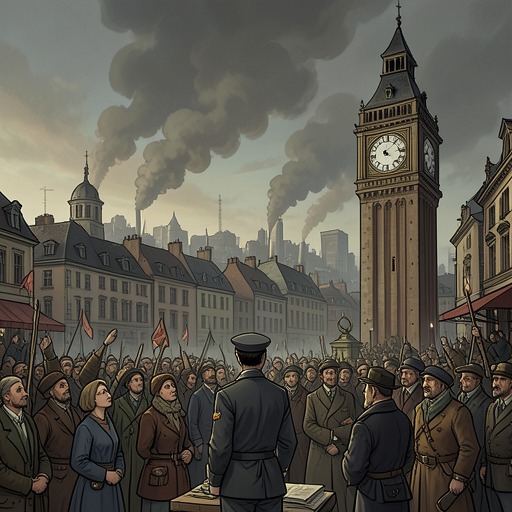
Congress of Religions
The King in YellowThe Congress of Religions is presented as a colossal public gathering whose aftermath appears to reconcile previously hostile religious communities. In the political history recalled by the narrator, it marks the moment when bigotry and intolerance were laid in their graves and kindness and charity began drawing warring sects together. The event therefore functions as a civilizational turning point: it converts religious conflict from a persistent social danger into a problem thought to have been overcome.
Background and Historical Setting
The Congress belongs to a future-oriented national history in which the United States has been reshaped by reform, centralization, and aggressive policies of self-preservation. The nation is described as prosperous, architecturally renewed, militarily organized, and increasingly confident in its ability to solve entrenched social problems. This setting matters because the Congress is not recalled as an isolated religious convention. It forms part of a sequence of changes that makes national calm appear attainable, even while Europe is said to be suffering under Anarchy.
The event follows or accompanies other major transformations, including the checking of immigration, new naturalization laws, the settlement of the independent negro state of Suanee, the solution of the Indian problem, and the gradual concentration of power in the executive. The narrator places these developments beside the Congress rather than separating spiritual reconciliation from state policy. Religious harmony thus appears within a broader program of national consolidation, prosperity, and self-preservation.
What the Congress Achieves
The central result attributed to the Congress is the burial of bigotry and intolerance. The language presents prejudice not merely as weakened but as something placed in a grave, while kindness and charity take its place as active forces capable of drawing warring sects together. The event’s decisive value shift is from organized religious antagonism toward inter-sectarian cooperation, and that shift is treated as sufficiently comprehensive that many people believe the millennium has arrived, at least in the new world.
No individual speech, delegate, doctrinal dispute, or ritual from the Congress is described in the supplied narrative. Its scale is conveyed by the adjective colossal and by the magnitude of the social consequence assigned to it. The Congress is important precisely as a collective historical intervention: it produces an altered religious climate rather than a single memorable hero or scene. The absence of procedural detail also gives the event a compressed, almost legendary quality, as though later national history has reduced a complicated gathering to its redemptive public meaning.
Religious Ritual and Its Contrastive Contexts
Elsewhere in the narrative, religious life is represented through concrete ceremonial spaces and bodily acts. At the Church of St. Barnabé, vespers end, clergy leave the altar, choir-boys settle into the stalls, a Suisse advances down the aisle sounding his staff at regular intervals, and Monseigneur C—— mounts the pulpit after making the sign of the cross. The scene is orderly, hierarchical, and enclosed within a traditional sacred space. The Congress, by contrast, is known through its social reach across warring sects, suggesting a movement from bounded ritual authority toward public religious reconciliation.
The book also repeatedly places Christian signs of prayer, sacrifice, and mourning beside danger, death, and historical rupture. A ruined shrine to the Virgin becomes the place where the narrator discovers the memorial of Jeanne d'Ys; a speaker asks a child to pray for France and for him; and a vision depicts blood poured upon white flowers. These episodes do not provide direct proceedings of the Congress, but they clarify the larger religious field in which its reputation operates. Faith can appear as ceremony, memory, sacrifice, or consolation, while the Congress represents the political hope that religious difference might cease producing hostility.
Political Consequences and Limits
The Congress is incorporated into the official story of national calm. Its achievement is presented alongside state measures that strengthen executive power and reorganize national institutions, so religious reconciliation contributes to the image of a disciplined and prosperous United States. The event’s moral vocabulary of kindness and charity is therefore compatible with a state that also defines belonging through exclusion and manages social problems through centralized authority.
That juxtaposition gives the Congress an important limit. The narrative does not demonstrate that intolerance has vanished from human nature; it records that many people believe the millennium has arrived. The claim is consequently collective and ideological rather than verified through every character’s conduct. Later episodes remain marked by dynastic obsession, threats of execution, insanity, war, and the Government’s claim to decide how citizens may die. The Congress can reconcile sects within the national imagination without dissolving the wider structures of coercion and violence that surround them.
Narrative Significance
As a remembered historical milestone, the Congress helps establish the alternate social order against which the book’s darker episodes unfold. It supplies evidence that the future is not simply technologically or militarily different but has been morally reorganized in its own self-description. The event also sharpens the contrast between public confidence and private catastrophe: a nation may celebrate charity between religions while individuals remain vulnerable to delusion, persecution, war, and death.
Its significance is thus double. On the surface, the Congress is the triumph of religious tolerance and a source of national optimism. Structurally, it is part of the book’s larger pattern in which institutions announce that suffering has been solved, even as the narrative repeatedly exposes suffering in intimate and violent forms. The Congress stands as one of the most powerful promises made by the transformed United States—and as a measure of the distance between official reconciliation and the unstable human world the stories continue to reveal.